
University of Johannesburg
South Africa
About University of Johannesburg |
University of Johannesburg, situated in Johannesburg - the focal point of South Africa's
mining, finance and manufacturing industries - was established in 1967
as the academic home of Afrikaans-speaking students of the
Witwatersrand. It was the aspiration of the Afrikaans community in the
Witwatersrand to establish its own Afrikaans university that would
specifically meet the educational needs of the fast-increasing
Afrikaans-speaking population of the Witwatersrand. University of
Johannesburg was intended,
through its Afrikaans spirit and character, to further and enrich the
culture, philosophies of life and pursuits of the Afrikaner nation.
As the first stage in the pursuit of an Afrikaans university, the
"Goudstadse Onderwyskollege" (the "Goudstadse"
College of Education) was established in 1961. Negotiations were also
entered into with the University of South Africa (UNISA) to move its
headquarters from Pretoria to Johannesburg, but the effort failed. On
4 August 1965, Minister Jan de Klerk announced that UNISA would remain
in Pretoria, but that an independent Afrikaans university would be
established for the Witwatersrand, with its headquarters in
Johannesburg. The government demanded, however, that at least R1
million be raised by the University Committee as a guarantee before
the necessary legislation for its own university would be tabled. By
June the following year, more than R2 million had already been raised
through donations.
The first meeting of the University Council was held on 7 December
1966, and on 1 March 1967, the first rector, Dr Gerrit Viljoen,
assumed office. The University was officially opened with an initial
staff complement of 50 and with 741 registered students, and its first
chancellor, Dr Nic Diederichs, was inaugurated at its temporary
premises (formerly a Braamfontein brewery) on 24 February 1968. The
motto of the University was: "Service through knowledge".
The University opened with four faculties, namely the Faculty of
Arts, the Faculty of Science, the Faculty of Commercial Sciences &
Administration and the Faculty of Law. In total, 53 subjects were
presented. The Faculty of Education would only be established two
years later.
In September 1967, a planning committee was formed to erect a new
University complex and campus in Auckland Park. For the first stage,
the Committee used 5 000 as a point of reference for the expected
total number of students. The Rector and the Registrar (Finances &
Operations) embarked on an extensive study tour of a large number of
universities in Germany, the Netherlands, Britain, the USA, Canada and
Japan. The first planning directive was subsequently submitted to the
architects in October 1968.
According to the planning directive, it had to be a modern
university, where students and lecturers could form a close-knit
community and where there would be ample opportunity to establish and
maintain interfaculty and interdepartmental liaison. The result was a
high-tech, compact, custom-built, multifunctional university complex a
mere four kilometres from the central business district of
Johannesburg, the capital of the Province of Gauteng. The unique
circular layout of the campus has the library, lecture halls,
laboratories, auditorium, cafeterias and sports fields within walking
distance of the student residences.
The new campus was inaugurated on 24 May 1975. In addition to the
University complex, students also moved into five new student
residences in 1975. This number would eventually increase to nine
on-campus student residences, as well as an off-campus student
village. The second chancellor, Dr Piet Meyer, assumed office on 6
April 1979, and the University bid farewell to Prof Viljoen, who was
appointed as the administrator-general of Namibia. The second rector,
Prof Pieter de Lange, assumed office on 10 September 1979. On the
death of Dr Meyer in 1984, Dr Gerrit Viljoen was appointed as the
third chancellor of the University in the same year. On Prof De
Lange's retirement, Prof Cas Crouse took over the rectorate on 1 July
1987. Prof Johannes van der Walt was appointed as the fourth rector of
University of Johannesburg in 1995.
Even though a curriculum group for the Engineering course of study
had been established in the Faculty of Science as early as 1971, a
Faculty of Engineering, with the departments of Civil, Mechanical and
Electrical & Electronic Engineering, was only allocated to
University of Johannesburg in
1981.
In keeping with its holistic approach to the development of its
students, the University provides an excellent sporting
infrastructure. At present, University of Johannesburg is maintaining 73 hectares of sports
grounds, offering first-class facilities for rugby, football,
athletics, tennis, squash, cricket, swimming and numerous types of
indoor sports.
Over the years, University of Johannesburg has also made a valuable contribution in the
realm of culture and research. University of Johannesburg Choir,
University of Johannesburg Symfo and University of Johannesburg Dramatic
Society were established in 1976 already, and the Gencor Gallery
became a sought-after venue for art exhibitions. University of
Johannesburg lecturers venture
overseas for research purposes regularly, and have published a great
many research articles in learned journals.
University of
Johannesburg's social consciousness finds expression in its commitment to
share its wealth of information and facilities with as many
communities as possible. Apart from serving its own support groups,
University of Johannesburg facilitates community development through academic upgrading, law
and drug-abuse clinics, a primary-health and eye-care train traversing
the country, youth programmes, community education programmes,
language improvement and other academic and practical projects both in
and outside Gauteng. The Department of Social Work, in turn, also
presents courses on a regular basis and undertakes many studies and
projects for the purposes of needs analyses.
University of
Johannesburg is currently the only university that manages its own school -
a high school for gifted children from historically disadvantaged
communities. University of JohannesburgCALL (University of
Johannesburg College for the Advancement of Learning and
Leadership) was established in 1992 and caters for hundreds of
learners.
Over the years, several bureaux and institutes were established at
University of Johannesburg, such as the Language Service, the Research Unit for Banking Law,
the Institute for Energy Studies, the Bureau for University Education,
the Centre for Islamic Studies, the Research Unit for Development
Studies and the Institute for Child and Adult Guidance.
In the early nineties,
University of Johannesburg gradually changed its perspective from
that of an exclusively Afrikaans university to that of a university
that is able to accommodate widely divergent student and language
communities. The full-time undergraduate and postgraduate tuition
programmes up to doctoral level are presented in Afrikaans and
English. Ample provision is made to accommodate English-speaking
students. English is the main medium of instruction in University of
JohannesburgNOX evening
programme of the University. The nation-wide University of
JohannesburgCEH (University of Johannesburg College for
Education and Health) programme is aimed at promoting the professional
upgrading of underqualified teachers and nursing staff from
disadvantaged communities. At present, approximately 21 000 full and
part-time students are enrolled at the University.
|
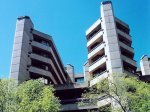
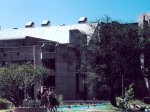
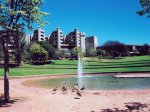
University of Johannesburg campus was established on an erstwhile golf-course of 77
hectares in the woody suburb of Auckland Park. The central group
of buildings consists primarily of a horseshoe-shaped chain of
buildings with a huge amphitheatre in the heart of it. The
north-eastern end of this horseshoe accommodates the library,
followed by the main entrance and four segments (called A, B, C
and D Rings) which in their turn comprise offices and
laboratories for the humanities. The north-western end of the
horseshoe is taken up by the University Club. A wide walkway
links all these segments on ground level.
Behind building segments C and D Rings, on the other side of
the walkway, are two lecture hall buildings (C and D Les) and
behind these two buildings, we find C and D Labs which house the
laboratories for Natural Sciences and which fan out from C and D
Les like spokes around an axle.
Accross from the walkway behind the B Ring segment are two
lecture halls (B Les 100 and B Les 101), which seat 640 students
each).
For ease of identification, the various building segments
have been colour-coded.
In 1998 the Sports Hall in the north-western part of the
horseshoe was changed into two lecture halls (E Les). The
Registration Centre was built above these lecture halls.
The amphitheatre, which is comparable in size to Church
Square in Pretoria, was designed to accommodate large groups of
people.
When planning the area, particular attention was given to the
creation of a landscape with indegenous plants. Furthermore,
provision was made for parking facilities to accommodate
approximately 2,500 vehicles. These parking lots are situated
directly behind A and B Rings and are also adjacent to C and D
Laboratories.
|
University of Johannesburg is fortunate in that it has a custom-designed, multifunctional
campus. The unique horseshoe-shaped layout of the campus has the
library, lecture rooms, laboratories, auditorium, shopping centre and
sports fields within a few minutes' walking distance of the student
residences. University of Johannesburg's design and functional layout assure a private and safe
environment for students, staff and visitors. The key feature of the
campus is accessibility.
It is true that there is no fine arts department at
University of Johannesburg, but the
University boasts one of the most dynamic arts environments in South
Africa. At least one arts-related presentation of international stature
is presented on campus every week. (There is often more than one
presentation per week!) In many cases, admission to these presentations
is free, and attendance is open to University of Johannesburg students and staff, as well as
the public
The Sports Bureau provides the infrastructure for
University of Johannesburg students to
participate in sport, and tries to make sport as accessible as possible
for all students. Sport is also used as a means of development in order
to support the University's mission of excellence at all levels. The
sports managers at University of Johannesburg are dedicated experts who are responsible for
specific types of sport.
University of Johannesburg
P.O. Box 524
Auckland Park
2006
South Africa
Cnr University and Kingsway
Auckland Park
South Africa
Tel:
+27
11 489-2911
Fax:
+27
11 489-2191
Website
Request Information:
Created by
Contact
Form Generator
| |
University of Johannesburg
P.O. Box 524
Auckland Park
2006
South Africa
Cnr University and Kingsway
Auckland Park
South Africa
Tel:
+27
11 489-2911
Fax:
+27
11 489-2191
Website
 |
