Study Theology at University of StellenboschThis
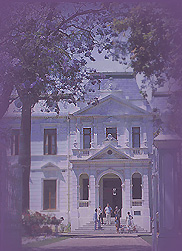
institution was originally established in 1859 as a Theological Seminary
to train ministers of the Dutch Reformed Church in South Africa (DRC).
This makes it the oldest institution of its kind in the country. It is
still accommodated in the same building, albeit with extensions. The DRC
became established in South Africa in the middle of the 17th century. In
1961 the Seminary amalgamated with the DRC Missionary Training Institute
(established in 1877 at Wellington, South Africa) and in 1963 it became
a Faculty of the University of Stellenbosch, which confers all degrees
obtained at the Faculty. The University was formally established in
1918.Historically speaking, the University of Stellenbosch used to be what was known as a 'white' University, but this has changed over the past two decades. Currently about 20% of the 18 000 strong student body are persons of color. Of the 340 students enrolled in this Faculty (under as well as post graduate), over 40% are persons of color. In January 2000 about 50 students and three lecturers from the Uniting Reformed Church in Southern Africa (URCSA - a mainly 'Colored' and black church) transferred to the Faculty for their studies. This has dramatically changed the profile of the Faculty. The DRC and the URCSA have been involved in church union talks for some time. Close ties have always existed with the DRC, but the Faculty has all along been accessible for students from other denominations to train here as well. With the entrance of the URCSA, a joint Church Advisory Board had already been established. This Board comprises of representatives of all denominations that enter into an agreement with the University of Stellenbosch to have their candidates for the ministry trained here. An official agreement had been signed in 2002 with the Uniting Presbyterian Church in Southern Africa who became a member of the Advisory Board. In addition, at postgraduate level in particular, a considerable percentage of students come from not only other denominations, but also from other countries, mainly in the African continent (but not exclusively). 
2. COMPOSITION OF FACULTY 2.1 The Faculty is entirely `national' or `indigenous,' i.e.comprising of South African staff. The majority are from a Reformed background, but a process has already begun whereby persons from other participating denominations are also being appointed as Faculty members. All permanent members of this Faculty hold doctorate degrees in Theology (full CV's can be provided, if required). Currently, there are twelve full-time Faculty members (6 Professors, 1 Assistant Professor, 4 Senior Lecturers and 1 Lecturer), plus one term appointment as Lecturer (initially for three years). A considerable number of academics, including emeritus professors and overseas guest lecturers, assist as visiting professors and in part-time teaching. These figures include three members representing URCSA and one member of the Moravian Church of South Africa. 3. LIAISON WITH VARIOUS INSTITUTIONS AND CHURCHES 3.1 The Uniting Reformed Church in Southern Africa as well as the Dutch Reformed Church in South Africa and the Uniting Presbyterian Church in Southern Africa maintain a Theological Training Board (Curatorium) which supervises the training of its ministerial candidates and provides spiritual care and nurture to them. These Boards liaise with the University on matters of mutual concern in terms of a written agreement. 3.2 The Faculty has, during the past years, taken definitive steps towards greater interdenominationality. Other denominations are currently becoming involved through the establishment of a more widely representative Church Liaison Council of the US (CLCUS). This development has been brought about in order to give expression to the aim of the Faculty to render service to the wider ecclesiastical community. This will also facilitate greater compliance with government policy regarding theological faculties at Universities, which are required to display a greater interdenominational character as well as diversity. 3.3 The Faculty has close ties with sister Faculties in the Universities of Pretoria and of the Free State. Links also exist with various other Faculties and Theological Training Institutions in the country. The Faculty is a member of the South African Council for Theological Education (SACTE) 3.4 The Faculty was instrumental in establishing an agreement between the University of Stellenbosch and the Cape Town-based Cornerstone Christian College (formerly known as CEBI - the Cape Evangelical Bible Institute). As from 1999 students studying there register at the University of Stellenbosch and obtain a three year BTS (Bachelor in Theoloical Studies) degree from the University while being tutored at Cornerstone. This program is offered entirely in English. 3.5 Towards the end of 1997 a lecturer, from the Moravian Church (Rev KT August) was appointed onto the Faculty. This post was made possible through a grant from CCLT - the Church Community Leadership Trust which is funded, inter alia, by the Ford Foundation. He is currently a fulltime staff member (Senior Lecturer). 3.6 Extended contacts and formal cooperative agreements (including exchange programs) have been concluded with the following Institutions:
These ties were strengthened and further formalized in April 2001 when an organization called Network for African Congregational Theology (NetACT) was established in Lusaka, Zambia, with seven institutions participating. The Faculty of Theology at Stellenbosch is the anchor institution for NetACT.  Click
here to visit the NetACT webpage (http: //www.sun.ac.za/theology/netact.htm) Click
here to visit the NetACT webpage (http: //www.sun.ac.za/theology/netact.htm)Another key Unit that plays an important role in the Faculty is the Unit for Religion and Development Research.
3.7 The Faculty has a close liaison with the Accrediting Council for Theological Education in Africa (ACTEA) and recognizes degrees (B.Th. or Licentiate in Theology) granted by ACTEA-accredited institutions. Graduates from such institutions may enter into postgraduate degree programs offered by the Faculty (either directly or via the Post Graduate Diploma). 3.8 Contacts and varying degrees of interaction have also been established with close on forty theological training institutions in South, Central and Eastern Africa. During 1997 and again in 1998 as well as in 2000 members of our staff personally visited all of these institutions 3.9.1 Exchange agreements involving both staff and students have been concluded with several overseas institutions, including the following:
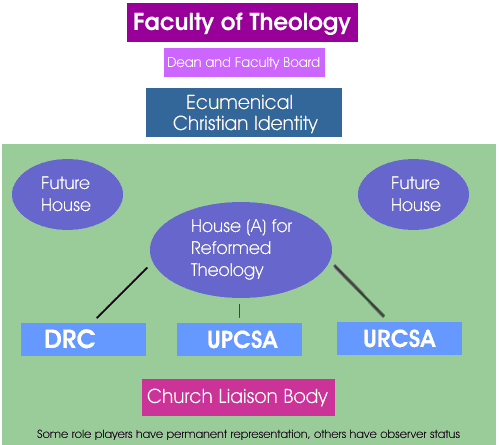
3.10 Individual members of Faculty are involved in a variety of joint research programs or mutual exchange programs with colleagues from other institutions on the African continent, the United Kingdom, Europe, USA, and Korea 4. THEOLOGICAL IDENTITY The Faculty of Theology, being a Faculty of the University of Stellenbosch, is an academic institution which seeks to practice theology in such a way that it renders service to church, society and science . At the same time it also recognizes its historic link with the Dutch Reformed Church in South Africa (DRC) and more recently with the Uniting Reformed Church in Southern Africa (URCSA), and the Uniting Presbyterian Church in Southern Africa, and hence with the Reformed Tradition. This link goes back 140 years to the time when the Dutch Reformed Church established the Seminary. Thus the traditional ethos of the Faculty is Reformed. Under Reformed theology the Faculty wishes to define itself as an institution which does Theology within a dynamic Scripture-oriented tradition, which acknowledges the authority of Scripture and its relevance for our day in promoting an integrated life style, mature faith and internalised values and norms. At the same time the Faculty places a high premium on ecumenicity by which it endeavours, in its relatedness to its African context, to participate in the broad ecumenical movement as well as to promote interdenominational interaction. This is done within the dynamics of both peculiarity (confessionality/identity) and communality (ecumenicity/unity). 5. THE MISSION, VISION AND VALUES OF THE FACULTY OF THEOLOGY 5.1 Identity and function Being part of the University of Stellenbosch, the overall objective of the Faculty of Theology is to so serve the church, community and science, bearing in mind our commitment to the African context and sensitivity for the concerns of different Christian traditions of faith. * The Faculty of Theology at the University of Stellenbosch is an ecumenical faculty. It provides facilities for the hosting and cultivating of Christian theology according to different confessional convictions and church traditions. * In order to maintain its ecumenical character, the faculty provides the capacity for the establishment of different Houses of Study. * Within the Faculty different Houses of Study have the responsibility to provide training and theological education according to their own confessional and denominational needs. * It is the responsibility of the Faculty to synchronize the different Houses of Study in order to establish cooperation and unity, as well as the provision of personnel, programs, student organizations, structures for training and the enhancement of a Christian spirituality. * Within the Faculty the Training School (Kweekskool) of the Dutch Reformed Church, the Theological School of the Uniting Reformed Church, and the Theological School of the Uniting Presbyterian Church in Southern Africa provide training and theological education in Christian Reformed Theology. [back] 5.2 Interpretation a] The Faculty is the structure and unit for theological education of the University of Stellenbosch. The Faculty is ecumenical and provides theological training in Christian theology. It is an open faculty and characterized by its Christian identity. b] The ecumenical character of the Faculty is reflected structurally in different Houses of Study. One House of Study for Reformed Theology has been established. c] Houses of Study refer to a specific confessional based theology; schools refer to denominations/churches and specific ministerial needs. d] Currently, there are 3 role players [entities] in the House for Reformed theology: the Kweekskool of the Dutch Reformed Church, the Theological School of the Uniting Reformed Church and the Theological School of the Uniting Presbyterian Church in Southern Africa. e] In order to enhance co-operation and efficient liaison, church representatives on the Board for Lecturers as well as a Church Liaison Body serve as links between the academic structure and the interests of the churches. [back] 5.3 A graphic representation of this structure:
Providing certain conditions are met, students who have completed the Postgraduate Diploma in Theology may apply to be admitted into a M.Th. program. Thus the Diploma also serves as a bridging course to enable candidates who otherwise might not have had the opportunity, to qualify for post graduate degree studies 6.2.7 D.Th. - a two-year (minimum) program involving the writing of a doctoral dissertation plus, where necessary subsidiary work; 6.2.8 Two postgraduate programs in conjunction with the Faculty of Arts:
7. STUDENT BODY AND FACILITIES AVAILABLE TO STUDENTS 7.1 While the majority of undergraduate students still come from the URCSA, the UPCSA and the DRC, the situation is considerably different at post graduate level where a large number of denominations are represented. 7.2 Both in terms of racial as well as gender composition the situation has continued to improve. Female students in the Faculty are up from 10% in 1996 to 20% at present, while the component of persons of colour enrolled in the Faculty now stands at around 50%. The first female Professor was appointed to the Faculty in 2000, and the first black lecturer (Xhosa speaking) from 2003. A considerable number of postgraduate students come from other countries on the African continent and many of these are prominent leaders in their churches and/or teach in theological institutions in the countries from which they come . 7.3 The Faculty houses a separate Theological Library which currently holds about 56 000 volumes and subscribes to more than 230 theological journals. This forms part of the larger University Library which holds a total of over 600 000 volumes and subscribes to over 5 500 journals, apart from 31 500 other items (i.e. microfiche, sound, cinematic and video materials). 7.4 The University operates HUMARGA, a large computer center which provides computer facilities as well as training to students in the Faculties of Arts, Theology, Law and Education (240 computers, 5 electronic teaching centers, scanners, Braille-transmitting facilities and access to Internet and E-mail). 7.5 In addition the Faculty of Theology has recently opened its own electronic media center for the use of faculty staff and students. The center provides computer facilities and training as well as access to various programs and data bases. These include Logos, CD Rom as well as other computer facilities. Several lockable study booths have also been installed at the Faculty for the use of postgraduate students or visiting researchers. 7.6 The University also offers training facilities to assist foreign students using English as a second language in acquiring the necessary linguistic and communication skills for their studies. 7.7 This facility is provided by the University's International Office which provides varied logistical assistance to foreign students throughout the process of applying, coming, residing and studying here (see website at: http: /www.sun.ac.za/international/). 7.8 The University offers rented accommodation for single students in a number of student hostels as well as in several residential houses reserved for students. A number of apartments, including apartments for married students are also provided. In addition a wide variety of outside accommodation can be obtained, ranging from rented rooms or flats in private homes to apartments run by private companies or agents. On the premises of the Faculty of Theology there are three apartments (each suitable for one or two persons sharing) which are intended primarily for short-term post graduate students or visiting lecturers. The joint URCSA/DRC/RCA Commission for Witness in the Western Cape, in co-operation with NetACT and the University have furbished private accommodation for up to fourteen single persons coming on short term study programs - mostly from neighboring countries from where they commute from time to time in terms of part time post graduate programs. Administration and bookings are done through the International Office of the University. 8. OPPORTUNITIES FOR FURTHER STUDIES AND THE NEED FOR SCHOLARSHIPS Apart from South African students of all races, i.e. Black, Colored, Asian and White (with the latter admittedly still somewhat in the majority) who study in our Faculty, we have, over the last eight to ten years (the 'New South Africa' era), experienced a growing interest in postgraduate studies from persons coming from various denominations and particularly from other countries within the African continent. Currently students (mostly ordained persons) in our postgraduate programs come, inter alia, from Namibia, Botswana, Zimbabwe, Zambia, Malawi, Mozambique, Kenya, Sudan, Uganda, Cameroon, Nigeria, Ghana and even Egypt. We believe this is happening not only because of the appreciation which exists for the academic standard and theological position of our Faculty, but also because there is a growing recognition of the value of doing postgraduate studies within the continent of Africa. Not only is this contextually much to be preferred, but also financially more attainable. A postgraduate student (single) studying full time, can be accommodated for about US$8 000 to 9 000 p.a. - this includes all fees, books, board and lodging, food and personal expenses and traveling between home and Stellenbosch once a year. Students studying on a part-time basis, including those doing non-residential programs, need even less. In terms of the priorities often laid down by sponsorship or funding organizations, a considerable number of candidates amongst those mentioned above would certainly merit support. Currently we have postgraduate candidates (to mention only those from within the rest of the African continent) who:
One of the major problems most of the postgraduate students in the above category face, is that of finance. Most, if not all, receive some help from their home churches, which, however, are mostly very poor. Others also receive support from institutions that are in some or other form of partnership with their home churches. Others find some support from elsewhere but very few have adequate access to funding. In several cases, severe hardships are being experienced, while others who have actually been admitted, have failed to take up the opportunity due to the lack of funds. The DRC, through its Theological Board of Trustees Bursary Committee, has taken a policy decision to assist all candidates from an African (Black) background, regardless of country or denomination of origin. But their funds are not sufficient to provide more than a fraction of what is really needed (currently, support of about US$400 p.a. each, and in some cases considerably more, is being provided to at least 25 persons who fall within the above category). We strongly believe that our Faculty, in conjunction with NetACT of which it is the anchor institution, is in a position to render effective and meaningful service to the church in Africa, particularly by training church leaders as well as teachers of future church leaders at a postgraduate level. Obtaining outside sponsorship or the support of bodies providing scholarship grants will certainly facilitate this and provide much needed support to churches within the African continent. To a lesser extent, support could also be solicited for the Korean postgraduate students, currently enrolled in our Faculty, but the need is much greater amongst African students. In presenting this fact sheet, we hope to promote more contact, interaction and co-operation not only with other theological institutions within the African continent and abroad, but also with various potential sponsoring bodies and scholarship programs. We would be happy to supply any further information that may be required. Information is also obtainable from our Faculty website (see below)
Website: http: //www.sun.ac.za/theology Request Information:
|
|
Stellenbosch
University Postal
Address:
Prof
DJ Louw | |||||||||||||||||||

 Click here to visit the URDR webpage
(http: //www.sun.ac.za)
Click here to visit the URDR webpage
(http: //www.sun.ac.za)